


Insights from the 2026 Data Spaces Symposium
On 10–11 February 2026, the latest edition of the Data Spaces Symposium brought together the global data community in Madrid, reflecting the growing momentum of data spaces as a key pillar of the data economy.
From our perspective at the Luxembourg National Data Service (LNDS), with CEO Bert Verdonck and Solution Architect Dragos-Constantin Stoica present on-site, the symposium highlighted a clear transition from conceptual discussions toward the practical implementation of data spaces.
The symposium combined plenary sessions with thematic tracks and featured speakers from Europe, Asia, Africa, and the Americas. Discussions covered a wide range of topics, from governance models and interoperability to AI Factories, cybersecurity, and applications in research and defense. While publicly funded initiatives continue to play a central role, growing industry participation signals an important step toward scalable and sustainable adoption.
The Blueprint v3.0
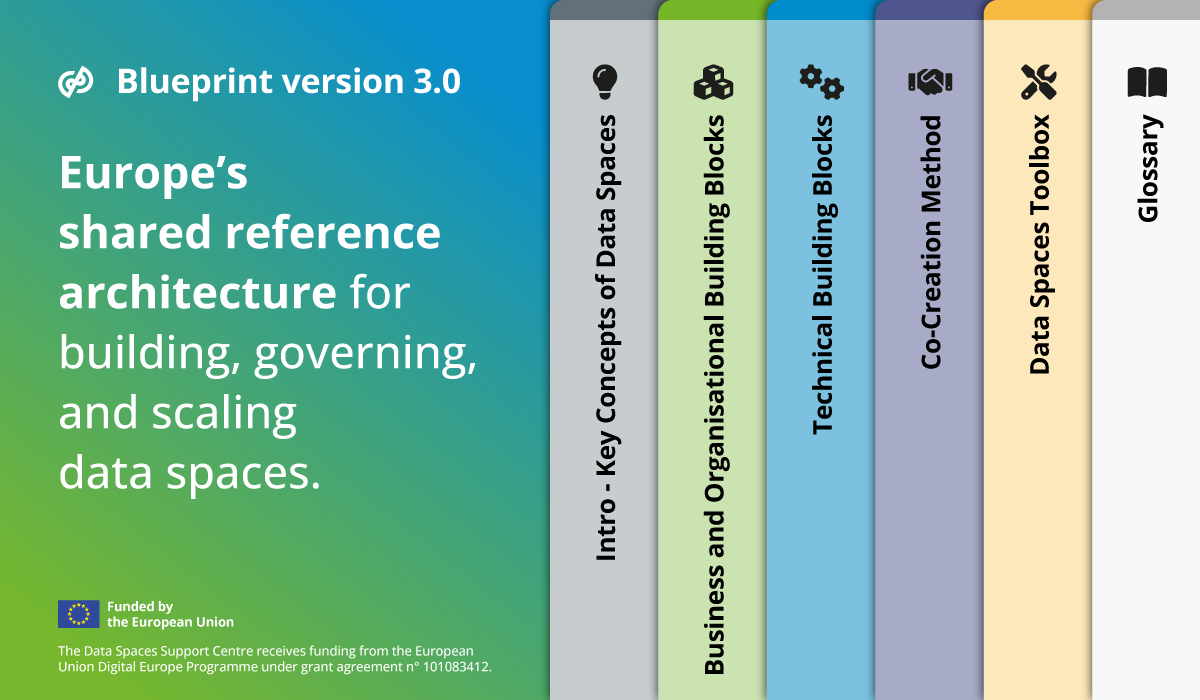
A major milestone of this year’s symposium was the official launch of the Data Spaces Supports Centre (DSSC) Architecture Blueprint v3.0, a structured architectural framework guiding the design and implementation of data spaces. Alongside it, the DSSC Toolbox equips stakeholders with practical components to move from concept to deployment.
Version 3.0 further strengthens guidance on:
- Interoperability mechanisms
- Governance and access management
- Data cataloguing and service catalogues
- Vocabulary, ontology, and data models
- Secure and scalable implementation approaches
The LNDS team actively contributed to the development of the Blueprint v3.0, particularly to the glossary, conceptual model, business, governance and legal building blocks.
Common challenges across domains
Despite covering different sectors, from health and mobility to defense and AI, the discussions revealed a set of remarkably consistent challenges:
Governance & access management
Defining who can access which data, under what conditions, and with which responsibilities remains complex and resource-intensive.
Interoperability
Technical, semantic, and organisational interoperability continues to be a key bottleneck. Shared vocabularies and aligned data models are essential for effective cross-border collaboration.
Value creation
A central question persists: how to translate participation into sustainable business models and measurable economic value.
Adoption and scaling
Industry stakeholders are calling for more concrete and scalable implementations. While pilot projects remain important, there is a growing demand for large-scale, operational use cases.
Data Spaces as infrastructure for the data economy
A strong and consistent message emerged throughout the symposium: data spaces are becoming mandatory infrastructure for the data economy.
They act as enabling layers for secure data sharing, innovation, and AI development at both national and European level.
While demonstrating immediate economic returns may not always be straightforward, the absence of data spaces will almost certainly lead to reduced competitiveness and missed opportunities. In this sense, they are not optional – they are strategic infrastructure for the future. As highlighted by our Solution Architect Dragos‑Constantin Stoica:
Data spaces are the future. If we want to move as a society to the next level of abstraction in using data, we must embrace data spaces.
Strong synergies with AI Factories
The relationship between data spaces and artificial intelligence emerged as a recurring theme throughout the symposium. Across multiple sessions, it became clear that AI systems fundamentally depend on access to high‑quality, well‑governed, and interoperable data. Data spaces provide the trusted and compliant framework required to make such access possible at scale.
From our experience at LNDS, supporting organisations across the data lifecycle – from governance and data preparation to secure processing – is essential to make these ecosystems operational in practice. In this sense, data spaces are not separate from AI ambitions – they are a key enabler of them.
Luxembourg’s position in the European landscape
Luxembourg is well-positioned in this evolving landscape, particularly in the context of the European Health Data Space (EHDS) and Common European Energy Data Space (CEEDS-INSIEME).
Its experience in secure data processing, governance frameworks, and cross-institutional coordination provides a strong foundation for contributing to European initiatives. There is clear potential to share practical implementation insights, particularly in governance structuring and operational deployment.
Open and collaborative ecosystems
The symposium highlighted the growing importance of open and collaborative approaches in the development of data spaces. Open solutions are increasingly seen as essential for creating sovereign, interoperable, and scalable ecosystems, promoting transparency, flexibility, and reduced dependency on single vendors – key elements for long‑term sustainability.
At the same time, valuable exchanges with international counterparts underscored the need for global alignment as data spaces become an integral part of the worldwide digital infrastructure agenda.
Looking ahead
The launch of the DSSC Architecture Blueprint v3.0 marks another step in the evolution of data spaces from vision to structured implementation.
The focus is now firmly on execution, scalability, and real-world impact.
Follow us for more news by subscribing to our newsletter.