


Data Maturity Assessment: building data governance foundations for the Environment Agency
The Luxembourg National Data Service (LNDS), has conducted a comprehensive Data Maturity Assessment in collaboration with the Luxembourg’s Environment Agency (Administration de l’environnement – AEV). The project provides AEV with an evidence-based understanding of its current data management practices and a structured foundation for the design and implementation of future data governance.
So what did this assessment actually imply in practice? Let’s take a closer look.
From data visibility to governance
As a public administration managing a wide range of environmental data, AEV works with diverse datasets across teams and activities. Following a data cataloguing initiative completed in 2024 – as described in our earlier article on moving from pilot to production – AEV improved visibility over its data assets and introduced shared tooling across departments.
However, while data became more visible, this also brought forward the importance of further structuring data governance across the organisation. This, in turn, highlighted the need for a broader, organisation-wide assessment of data maturity – one that could establish a clear baseline and guide the next phase of governance development. In practice, this means ensuring that data is not only visible, but also consistently understood, managed, and reusable across the organisation.
Thirteen AEV departments participated in the process, ensuring a complete organisational perspective.
The Data Maturity Assessment aimed to:
- establish a clear baseline of data management maturity across all AEV departments,
- identify systemic strengths and gaps,
- prioritise governance actions based on impact and feasibility, and
- provide a robust analytical foundation for the next phase of data governance.
A structured assessment approach
The assessment was built around a structured questionnaire administered through the Data Stewardship Wizard (DSW) platform. The questionnaire was adapted from the UK Government Data Maturity Assessment Model and tailored to AEV’s organisational context, mission, and operational realities.
In total, the assessment covered 114 questions, addressing key dimensions such as governance, data quality, skills, tools, lifecycle management, ethics, and user engagement. Rather than applying maturity scores mechanically, results were assessed holistically, combining narrative evidence and expert input. Maturity levels ranged from Beginning to Mastering, reflecting the progression from limited awareness to fully embedded organisational practice.
This work was carried out through our Data Management and Stewardship Service (DaMSS), combining methodology, tools, and facilitation.
The impact of the assessment can be seen across several levels.
Impact: what changed across AEV
Beyond producing analytical results, the assessment created a shared understanding of data maturity across the organisation.
At an organisational level:
- full participation across departments created a coherent and shared baseline,
- department heads and operational experts actively contributed through facilitated sessions, and
- AEV’s Data Steward fully appropriated the tools and methodology used during the assessment, enabling future reuse of the framework and supporting continuous improvement.
At the same time, the process also contributed to a broader cultural shift:
- a shared language around data maturity emerged, and
- awareness of data-related responsibilities, challenges, and opportunities increased across the organisation.
From a governance perspective, the assessment identified a set of high-impact, high-feasibility actions, providing clear entry points for structured implementation.
Finally, the methodology itself proved reusable, with the framework, questionnaire, and analysis model documented for application in other contexts.
What the assessment revealed
The results point to a heterogeneous data management landscape across AEV, with varying levels of maturity between departments. Several departments have made progress in developing structured data practices. This assessment marks a starting point for improvement, based on self diagnosis, rather than an evaluation of a fully established data governance framework.
This should not be seen as a limitation, but as a clear starting point. The assessment establishes a realistic baseline from which progress can be measured and guided, enabling a shift from individual initiatives toward a more consistent and coordinated governance approach.
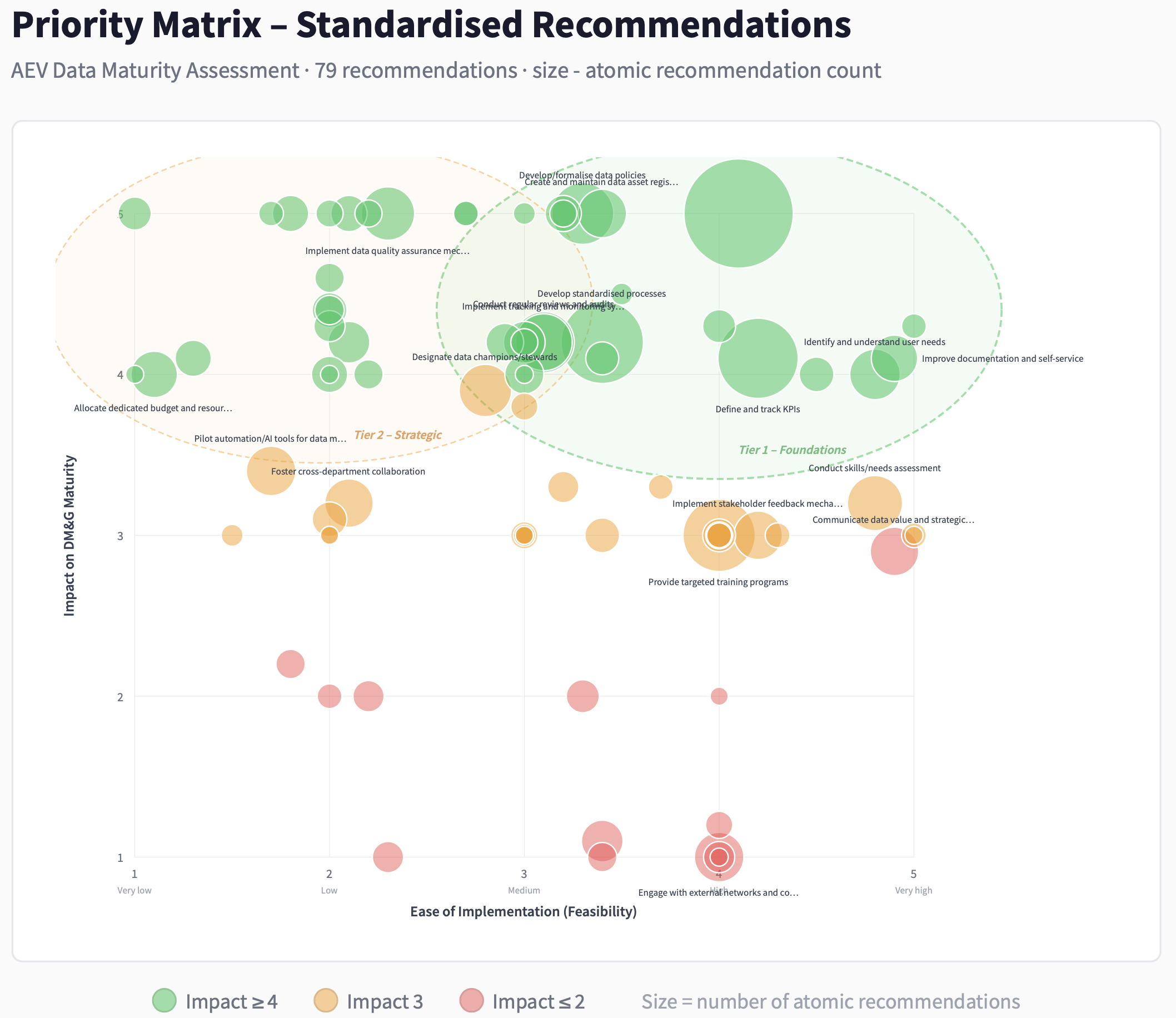
To translate findings into concrete next steps, recommendations were prioritised using an impact–feasibility matrix and grouped into three strategic tiers:
- Foundations (high impact, high feasibility)
These represent the most actionable priorities and include defining clear data roles and accountability, improving documentation and self-service resources, and more. Over half of all atomic recommendations fall into this category, indicating that the most impactful actions are also realistic to implement in the short term.
- Strategic investments
These recommendations offer high impact but require greater organisational and technical effort, including data quality mechanisms, access controls, and lifecycle management. They form the natural next step once foundational governance elements are in place.
- Contextual actions
Lower-impact recommendations, such as external networking, remain valuable but are unlikely to drive substantial maturity gains until core governance structures mature.
Outlook: from baseline to transformation
The AEV Data Maturity Assessment marks a new milestone in AEV’s data journey. Its outputs provide the evidence base, prioritised roadmap, and analytical framework needed to move toward a coherent and sustainable data governance practice.
Importantly, AEV is not starting from zero. The presence of a dedicated data steward role, strong leadership engagement, and momentum from prior initiatives create favourable conditions for turning assessment insights into concrete action. This supports more efficient use of data across the organisation and helps address risks such as duplication or underuse.
As a repeatable and adaptable methodology, the assessment also illustrates our approach to supporting public administrations in building practical, evidence-based data governance capacities.
Learn More
Discover how our LNDS team supports organisations in building structured and scalable data governance through its Data Management and Stewardship Service (DaMSS).
You can also explore how this collaboration started in our earlier article – Moving from pilot to production: building full data inventory at the Environment agency.