


Beyond the hype: what SCynergy 2026 reveals about AI, data, quantum, and trust
On 14–15 April 2026, SCynergy brought together the European ecosystem around AI, high-performance computing (HPC), and quantum technologies at the Chamber of Commerce in Luxembourg. Across two days of panels, keynotes and technical sessions, discussions spanned a wide spectrum – from AI adoption and startup dynamics to quantum computing, infrastructure, and sector-specific applications such as cybersecurity and health.
What stood out, however, was not a single topic, but the tension between them. While technological capabilities are advancing at an exceptional pace, many conversations kept returning to a more grounded question: how do we use these technologies in practice – responsibly, efficiently, and in ways that deliver real value beyond the demo stage?
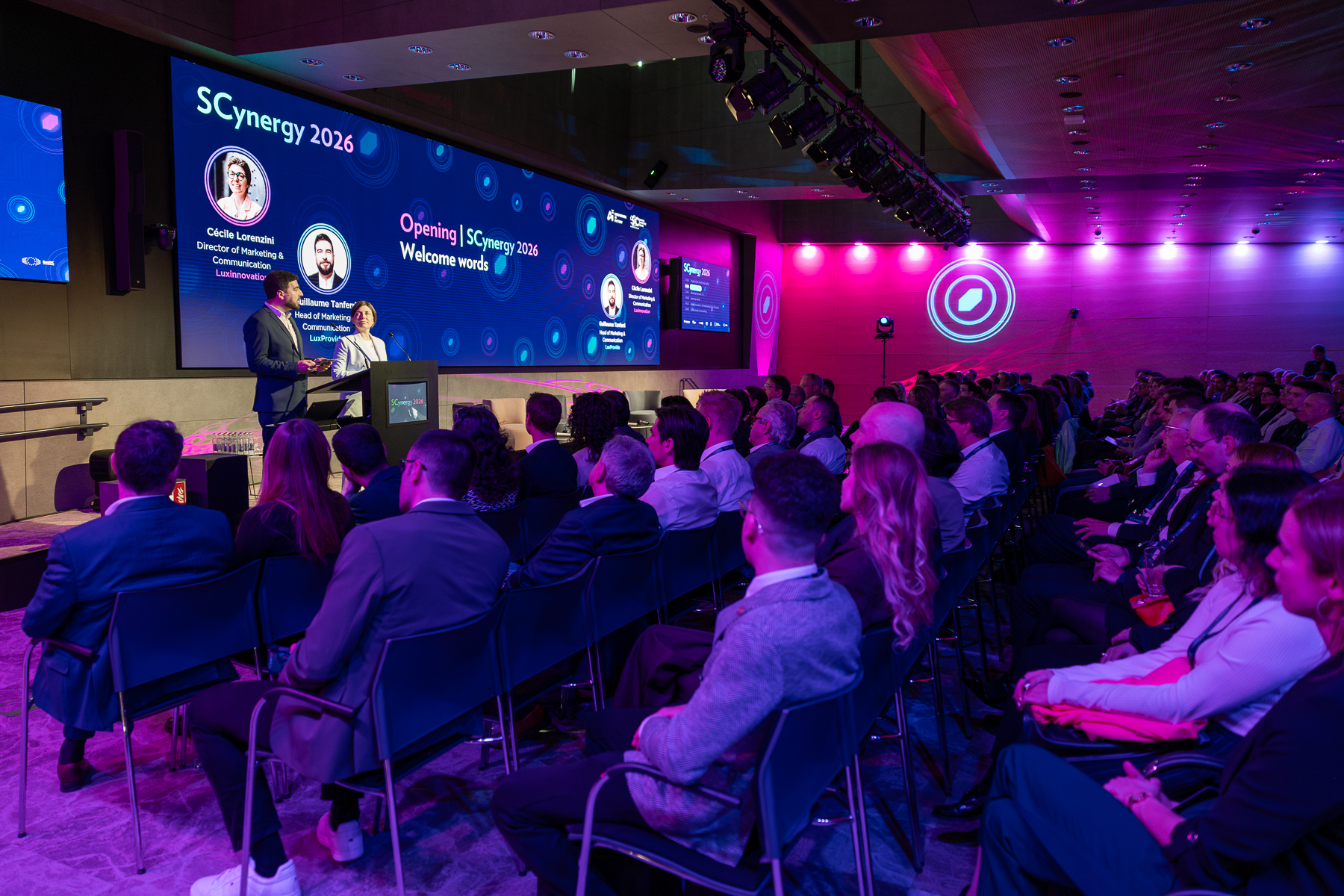
Opened by Prime Minister Luc Frieden and followed by contributions from Minister Stéphanie Obertin, the event highlighted not only technological progress, but also the role Luxembourg plays within Europe’s advanced technology ecosystem.
From infrastructure to real use: what it takes to make AI work
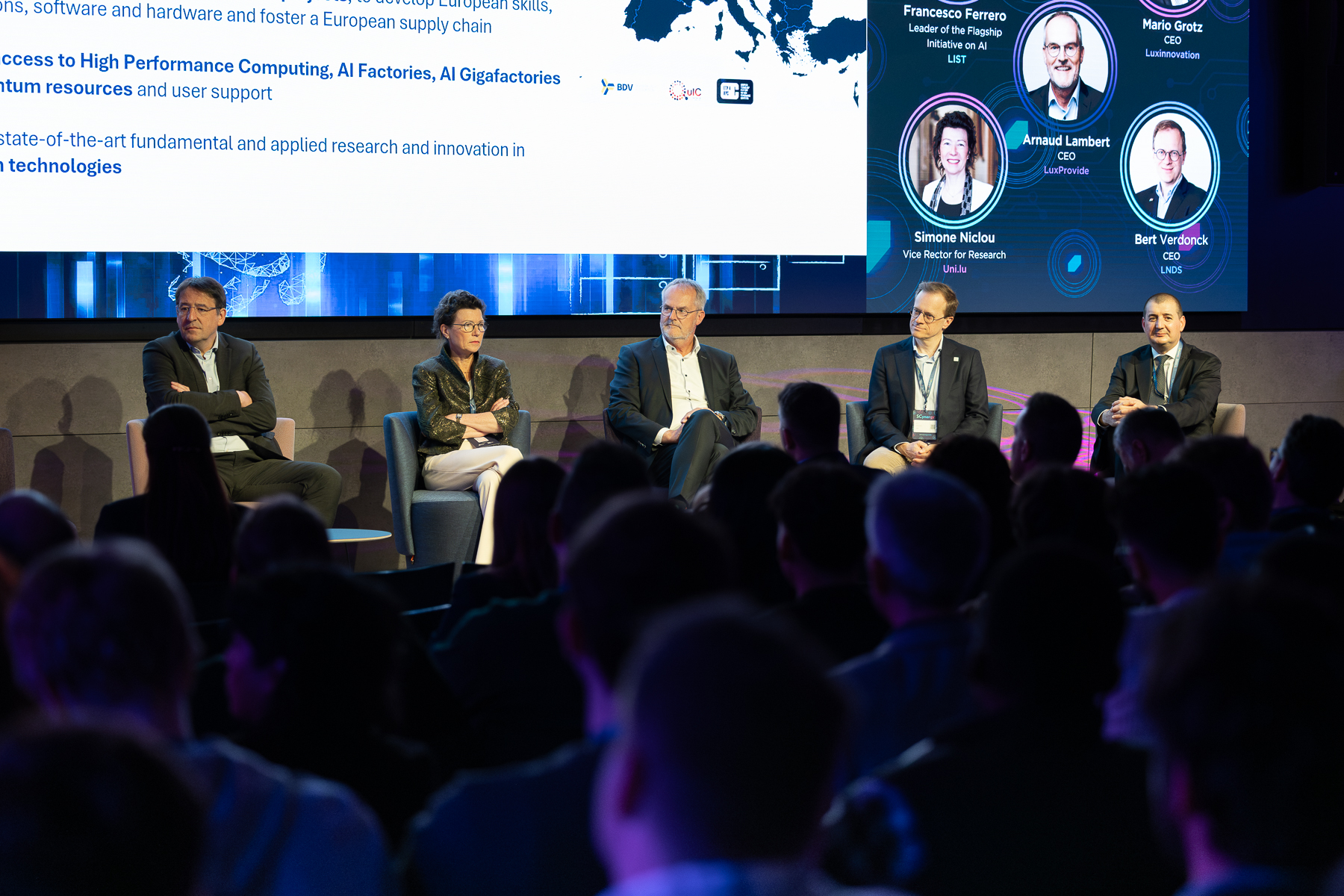
This question came into sharp during the panel on orchestrating AI Factories, which brought together several members of the Luxembourg AI Factory consortium, including Bert Verdonck, CEO of Luxembourg National Data Service (LNDS). The discussion showed that an AI Factory cannot be reduced to infrastructure alone. It depends on many connected layers: compute, data governance, technical tools, training, sector expertise and support for organisations that want to adopt AI in practice.
From the LNDS perspective, the discussion highlighted a challenge that is becoming increasingly central to AI development: enabling trusted data reuse across multiple organisations, sectors, and borders. As Bert illustrated, even a labour market analysis may require data from several sources – job vacancy platforms, company surveys and social security systems – each with its own sensitivities, rules and constraints. This is where data spaces become essential. Rather than centralising data, they provide a framework to manage governance and enable collaboration while keeping data under the responsibility of its owners.
Equally important are the layers that come before any AI model is trained. Before data can be used for AI, it often needs to be prepared, cleaned, anonymised or pseudonymised. These preprocessing steps are often the most time-consuming and least visible part of AI development.
Seen this way, making AI work is not only about having the right infrastructure. It also depends on the layers that connect data to use: governance, preparation, reusable tools and trusted collaboration.
Innovation is also a human challenge
One of the keynotes took a step back from technology and focused on something more uncomfortable: we are not evolving at the same speed as the systems we are building.
Sébastien Bohler, Editor-in-Chief of Cerveau & Psycho, reminded the audience that while technological innovation moves extremely fast, our cognitive and emotional responses change much more slowly. Our behaviour, attention span, and decision‑making processes are still shaped by mechanisms that have remained largely unchanged over time. Meanwhile, the environments we operate in are becoming more complex, faster, and more demanding.
That gap shows up everywhere: in how we react to information, how we prioritise short-term with long-term decisions, how easily we fall into habits driven by immediate rewards.
Technology moves fast. Humans.. not so much.
This is not only a philosophical observation. It has practical consequences for how we design and adopt new systems. If technological change is moving faster than people can cognitively and emotionally absorb, then responsible innovation also means paying attention to how people understand, use and respond to these systems. Designing better technology therefore also means designing better interactions.
Quantum as readiness, not science fiction
The discussions around quantum computing framed it as an emerging capability to prepare for, rather than a technology to apply everywhere. The key question is where quantum can add value, how it complements existing computing systems, and what organisations should start understanding now.
It was clear that quantum is not expected to replace classical computing or HPC. It is more likely to work alongside them in hybrid environments, helping with specific and complex problems such as simulations, optimisation, machine learning acceleration, cryptanalysis, and modelling new materials or molecules.
The session also made clear that the field is still evolving. Hardware approaches differ, scalability remains difficult, and integration with classical systems is still a challenge. The takeaway was practical: organisations do not need to wait for quantum to become mainstream before engaging with it. They can already start building understanding, testing relevant use cases, and preparing for where quantum may eventually fit.
AI is no longer “new” – and that changes the conversation
Another notable shift emerged across many discussions: AI is no longer seen as something new. It is becoming part of the everyday technological landscape. As a result, the conversation around it is becoming more grounded. Instead of asking what AI could do, people are increasingly focused on what it should do, how much it costs, and where it genuinely adds value.
The growing normalisation of AI may be one of the clearest signs that the technology is entering a more mature and meaningful phase. AI is no longer treated as an end in itself, but as one tool among others — to be used carefully and purposefully.
As the focus shifts towards the impact AI creates — technically, economically, socially and environmentally — another question also comes into focus: what does AI consume in order to deliver that value?
This point was highlighted by Daniel Meyer from Fujitsu Luxembourg, who reminded the audience that every interaction with AI comes with a cost – in energy, resources and infrastructure. As AI becomes more widely embedded in tools, services and organisational processes, this cost can no longer remain invisible. The point is not to oppose AI and sustainability, but to bring them into the same design conversation. If AI is to deliver long-term value, performance cannot be the only measure. Efficiency, resource use and environmental impact need to be considered from the start, not added later as an afterthought.
What stays after two days
After two days of exchanges and debates, what remains is not a list of technologies, but a broader understanding of how they come together.
Artificial intelligence, high‑performance computing, and quantum technologies do not exist in isolation. Neither do startups, infrastructure providers, policymakers, or researchers. The real challenge, and the real opportunity, lies in connecting all of these elements in a way that makes systems usable, trusted and relevant beyond the demo stage.
Across the programme, this became visible in different ways. Innovation is rarely about a single breakthrough. It is about coordination. It is about making complex systems understandable and accessible. And while the technologies themselves matter, their impact depends just as much on the conditions around them: how people behave, how decisions are made, how organisations adapt, and how trust is built into the process.
Technology may enable new possibilities, but human choices determine whether those possibilities become real value.
The future of innovation is therefore neither entirely technological nor entirely human. It sits at the intersection of both. And mastering that balance may well be the most important challenge ahead.
About the Luxembourg AI Factory
The Luxembourg AI Factory brings together partners across infrastructure, research, innovation and trusted data reuse to support AI adoption and development in Luxembourg and Europe.
Consortium members include: Luxinnovation, Luxprovide, University of Luxembourg, Luxembourg Institute of Science and Technology (LIST), Luxembourg National Data Service (LNDS).